Scene studyGuide
How to break down a scene, step by step
A seven-step method for turning any scene into specific, playable choices, shown on one short sample scene from the first read to a finished breakdown.
Most "bad" auditions aren't bad acting. They're vague choices. The actor understood the scene but never turned that understanding into something specific to do. Breaking down a scene is how you close that gap. Here's a step-by-step method you can run on any scene, from a self-tape to a callback, shown on one short scene all the way through.
The scene we'll use
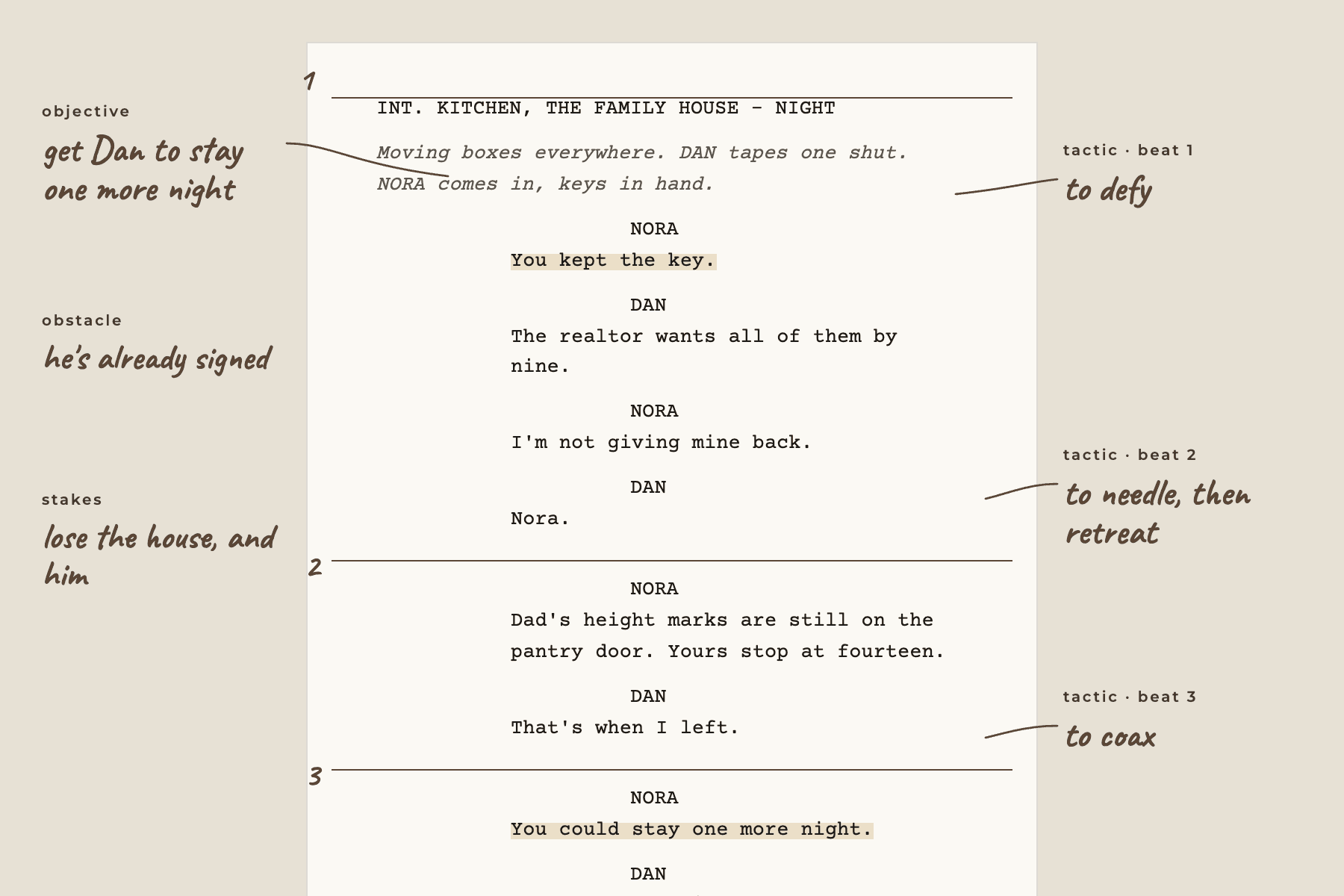
We wrote this short scene for this guide so you can watch one breakdown develop from start to finish. We'll work from NORA's side.
Nora
Dan
Nora
Dan
Nora
Dan
Nora
Dan
Nora
Dan
Nora
Dan
Nora
1. Read it three times (for three different things)
- First read: story. What actually happens? Who are these people to each other?
- Second read: your character. What do they want, and what's in their way?
- Third read: the shifts. Where does the scene turn? Mark every moment something changes.
Resist the urge to "perform" while you read. You're gathering information first.
Worked example · three reads
- Story: a brother and sister are clearing out their family home the night before it's handed over. He has already signed the sale.
- Nora: she wants one more night in the house with him. In her way: he's already let go, and the paperwork is done.
- Shifts: the scene turns at "Dad's height marks", at "You could stay one more night", and hardest at "I signed this afternoon."
2. Find the objective (what your character wants)
Phrase it as an active verb aimed at the other person: I want to make you stay. I want to make you admit it. I want to protect you. A strong objective is specific, urgent, and hard to get.
Worked example · Nora's objective
- Too general: to say goodbye to the house.
- Better: to get Dan to stay.
- Playable: to get Dan to spend one more night here with me, which really means getting him to admit that this place matters to him too.
3. Name the obstacle and the stakes
- Obstacle: what's stopping you from getting your objective right now? (The other person, a secret, the time, your own fear.)
- Stakes: what happens if you don't get it? The higher and more personal the stakes, the more alive the scene.
If the stakes feel low, you haven't found them yet. Keep digging until the scene matters.
Worked example · obstacle and stakes
- Obstacle: Dan has already decided, and already signed. He's handling his feelings by working. And Nora's pride stops her asking plainly until the very last line.
- Stakes: after tomorrow at nine, there is no family house. If Nora can't reach Dan tonight, she suspects she'll lose him the way she's losing the house: politely, without a fight.
4. Break the scene into beats
Draw a line every time the scene turns. Most short scenes have three to six beats. Naming them stops you from playing the whole scene on one note.
Worked example · four beats
- The key (from "You kept the key" to "Nora."). Nora draws a line in the sand.
- The pantry door (to "That's when I left."). She reaches for a shared memory, and touches his wound instead.
- One more night (to "You held the flashlight."). She asks, indirectly, and he deflects with logistics.
- I signed (to the end). The news lands. Her only move left is to ask him directly.
5. Choose a tactic for each beat
Within your one objective, how you pursue it changes from beat to beat. When one tactic fails, your character tries another. That's what makes a scene feel like it's actually happening.
Worked example · Nora's tactics
- Beat 1: to defy him. She refuses to hand over the key.
- Beat 2: to needle him with the past, then back off when it hurts him.
- Beat 3: to coax him, using a warm memory as bait.
- Beat 4: to disarm him. She gives up the key and asks plainly.
Notice that the tactics get more vulnerable as the scene goes on. That progression is the scene's shape.
6. Anchor it in given circumstances
Who, where, when, and what just happened before the scene starts? Specific given circumstances make your choices concrete. "I just got the phone call" plays completely differently from "it's an ordinary Tuesday."
Worked example · given circumstances
- Where: the kitchen of the house they grew up in, now mostly boxes.
- When: the night before the keys are due back at 9 a.m.
- Just before: Nora has driven over alone, probably without telling Dan she was coming.
- The history the script gives us: Dan left home at fourteen. Their father measured them on the pantry door.
Anything beyond what the script gives you is a choice. Make it, but know it's yours, and be ready to change it.
7. Leave room to be surprised
A breakdown isn't a cage. It's a launch pad. Make strong choices, then let them go in the room so you can actually listen and respond. The paperwork is what frees you to be present.
The completed breakdown
Here's the whole thing on one page: the version you'd actually keep next to your sides.
Objective: to get Dan to spend one more night here with me. Obstacle: he's signed and shut down, and my pride. Stakes: losing the house tonight, and maybe him with it.
| Beat | What happens | Nora's tactic | What ends the beat |
|---|---|---|---|
| 1. The key | She refuses to hand over the key | To defy | Dan's "Nora." shuts the argument down |
| 2. The pantry door | She brings up their father's height marks | To needle, then retreat | "That's when I left": she's touched a wound |
| 3. One more night | She asks him to stay, wrapped in a memory | To coax | "I signed this afternoon" |
| 4. I signed | She lays down the key and asks directly | To disarm | The scene ends on her question |
Practice: break down your current sides
Practice exercise
The 20-minute breakdown
- Task
- Break down a scene you're currently working on, or any two-person scene you have to hand.
- Time
- 20 minutes, plus 5 minutes on your feet
- Read the scene three times, once each for story, your character, and the shifts (5 minutes).
- Write one objective as "to get [them] to…" (2 minutes).
- Write the obstacle and the stakes in a sentence each (3 minutes).
- Draw a line at every turn and title each beat in two or three words (5 minutes).
- Give each beat one tactic verb (5 minutes).
- Stand up and say the lines, playing only the tactic for each beat. Notice where a tactic feels wrong, and change it.
OutcomeOne page with an objective, an obstacle, stakes, marked beats, and a tactic for each beat, ready to try out loud.
Make it a habit
Doing this the same way every time turns preparation from a scramble into a practice. The method stays the same, so the effort goes into the choices instead of remembering the steps.
Questions
What does it mean to break down a scene?
Breaking down a scene means reading it closely to find what your character wants (objective), what stands in the way (obstacle), what's at risk (stakes), and how the scene moves in beats, then turning that into specific, playable choices instead of a general mood.
How long should a scene breakdown take?
For an audition scene, 20–40 focused minutes is plenty once you have a system. The point isn't to over-analyze; it's to make a few strong, specific choices you can commit to and adjust in the room.
Do I need to break down a scene if I'm improvising or cold reading?
Even in a cold read you can do a 60-second version: find the relationship, the want, and the obstacle. A lightweight breakdown is what keeps a cold read from turning into a flat line-read.
Written by
The people who design Vitoniou's journals and workbooks for actors and film creatives. We write these guides to teach the methods our printables are built around, and we update them when we improve them.
Sources
- Constantin Stanislavski (trans. Elizabeth Reynolds Hapgood). An Actor Prepares. Theatre Arts Books, 1936. The source of the objective, super-objective, and units-of-action vocabulary that modern scene study builds on.
Read next
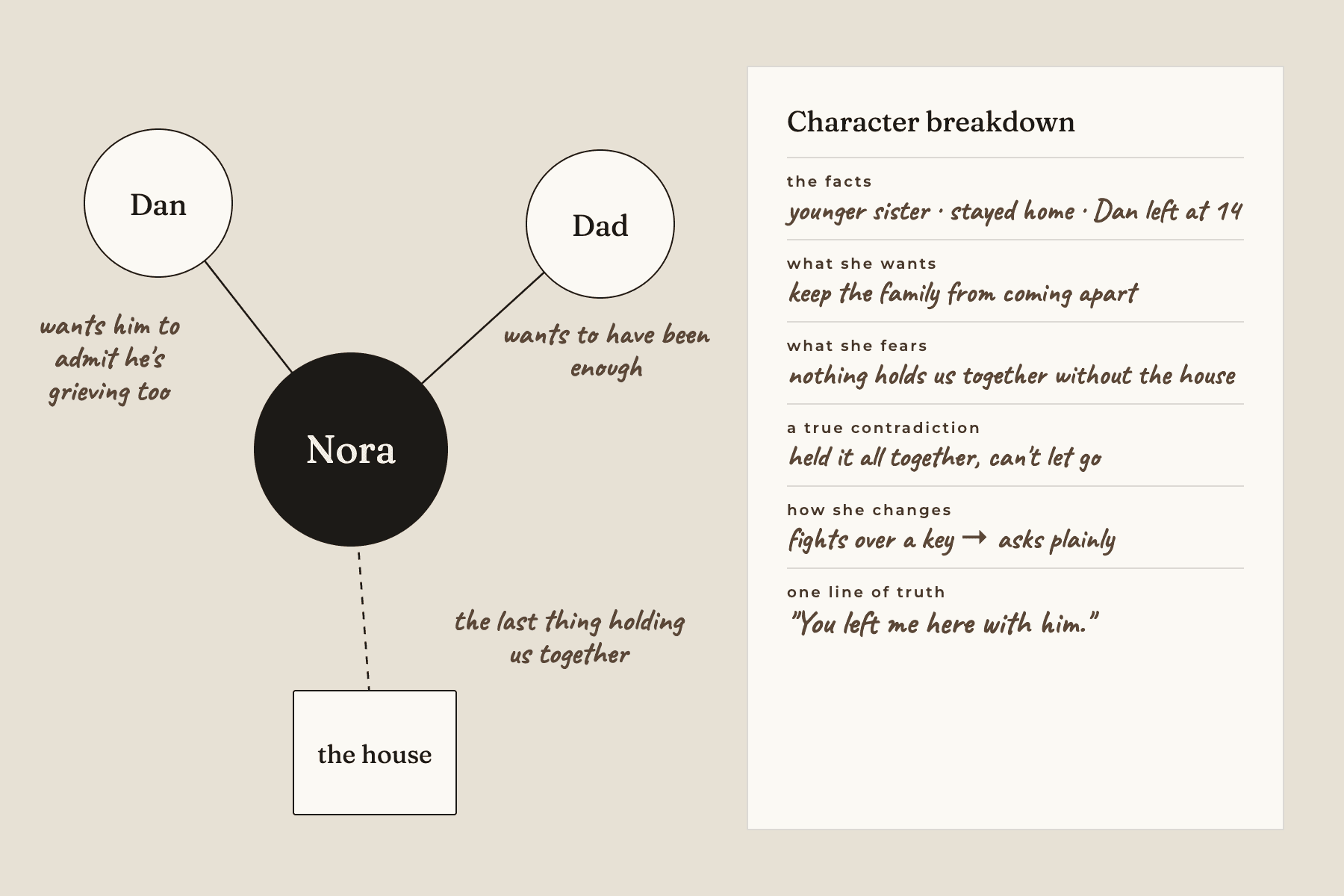
Character workWorksheet
The actor's character breakdown worksheet
A free printable character breakdown worksheet for actors: the questions that turn a role on the page into a specific, living person you can play.
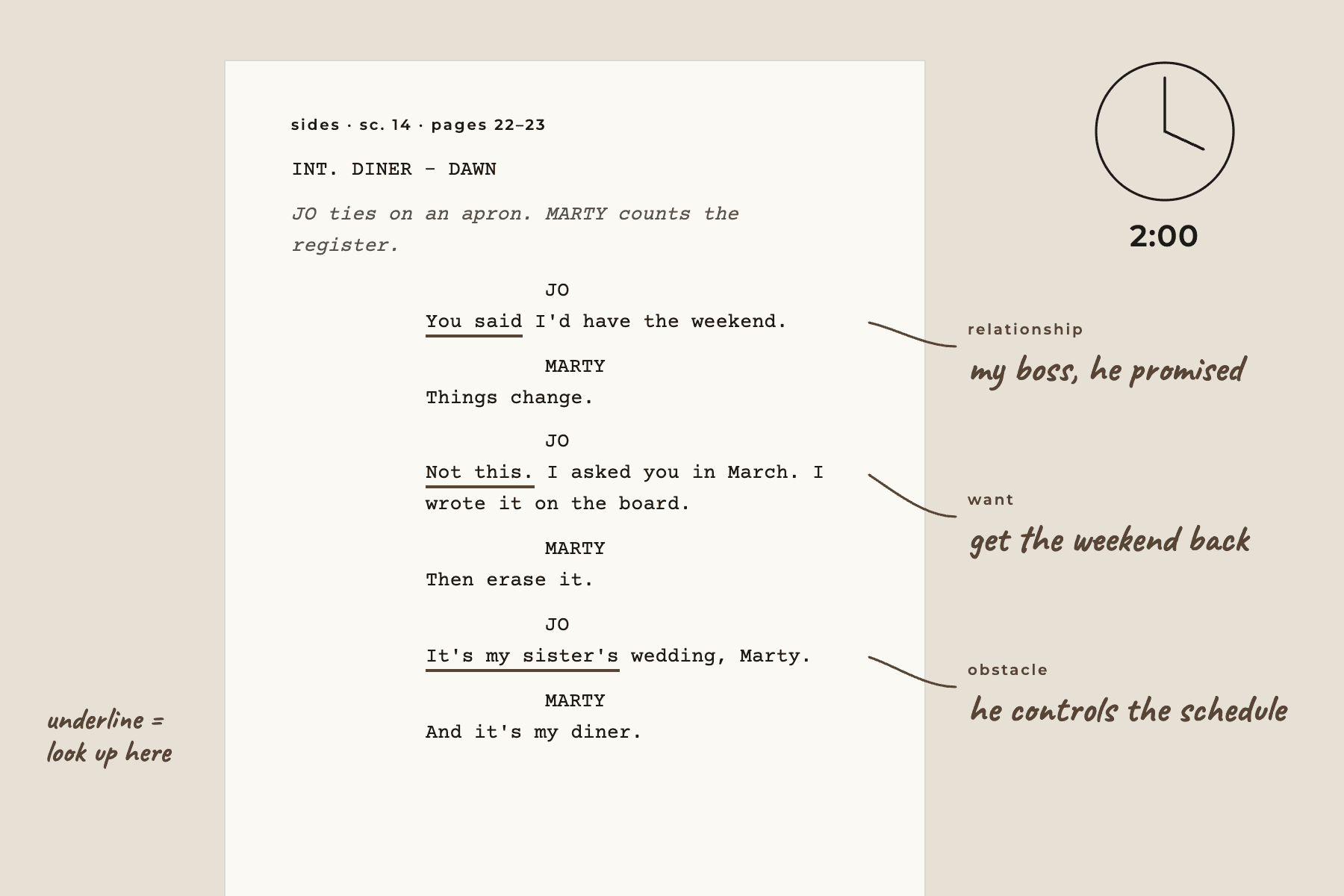
AuditionsGuide
Cold reading tips that actually work
Practical cold reading tips for actors: how to make fast, specific choices, use the sides, and stay present when you get the scene minutes before the audition.