Acting techniqueGuide
Acting techniques explained: what each one asks of you
Eight major approaches, from Stanislavski's system to Viewpoints, compared side by side and tried on the same line of dialogue so you can feel the difference.
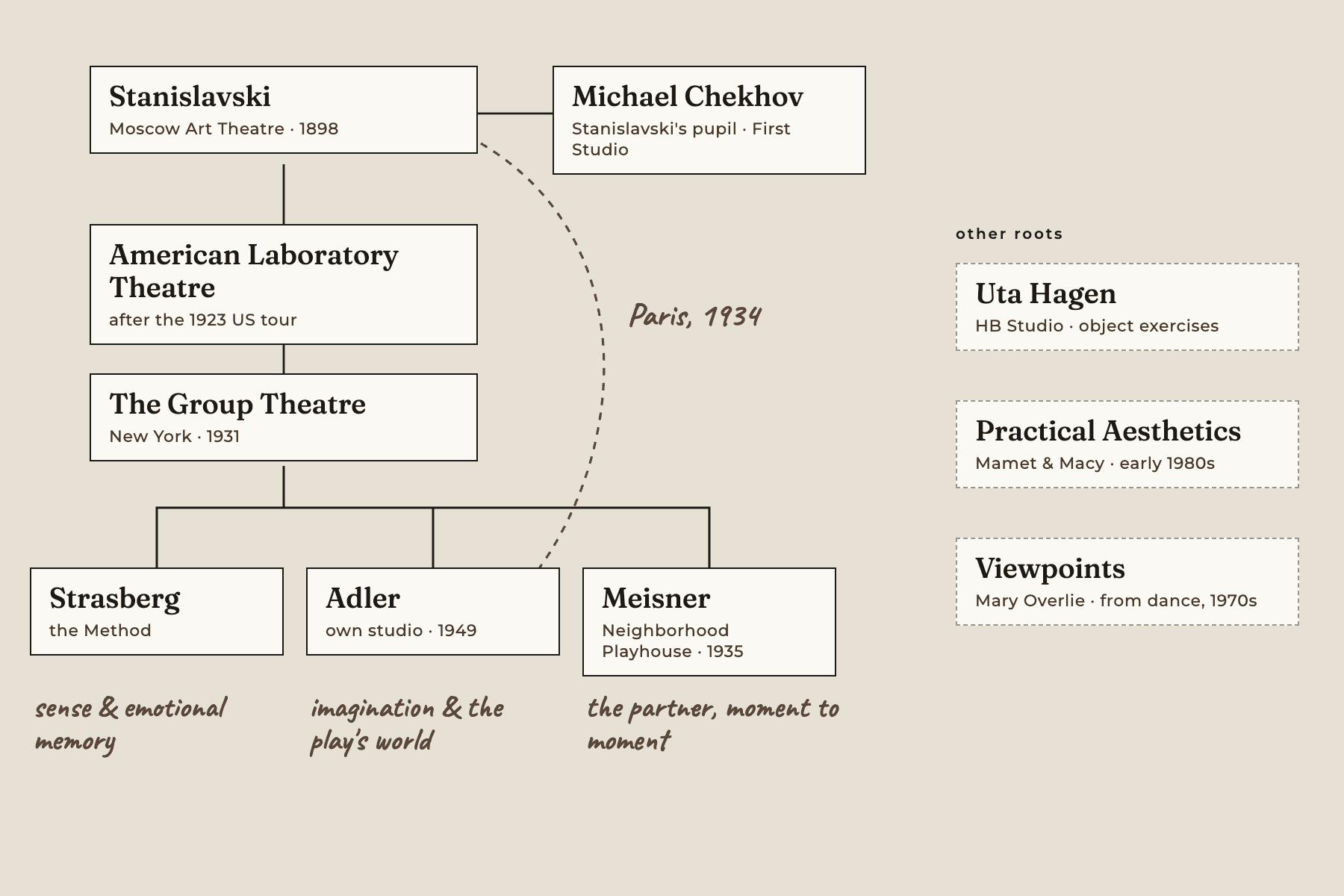
If you've been told to "take a Meisner class", heard someone describe themselves as a Method actor, or seen a school promise the "real" Stanislavski, you've met the problem: the major acting techniques share a vocabulary, borrow from each other, and argue about history. This guide sorts them out. For each one you'll get where it came from, what it asks you to work from, its key terms and exercises, and where it's taught today. Factual claims are sourced (the list is at the end), and the same line of dialogue is worked through each approach so you can feel the difference.
The short version
Here is each technique reduced to the question it trains you to ask. The questions are our summary, so read the sections below for each school's own words.
| Technique | You mainly work from | The question it asks | Signature exercise |
|---|---|---|---|
| Stanislavski's system | Given circumstances, objectives, imagination | What do I want, in these circumstances? | Breaking the script into bits and tasks |
| Strasberg's Method | Your own sensory and emotional memory | What have I lived that makes this real? | Sense memory exercises |
| Stella Adler | Imagination and the world of the play | What does the play's world let me imagine? | Script interpretation and research |
| Meisner | Your partner, moment to moment | What is my partner doing to me right now? | Repetition |
| Uta Hagen | Your own lived reality, concrete behavior | What would I really do here? | Object exercises |
| Michael Chekhov | Imagination through the body | What shape and atmosphere does this person move in? | Psychological gesture |
| Practical Aesthetics | A playable action, then your partner | What am I literally doing, and what is it like for me? | Four-step script analysis |
| Viewpoints | Space, time and the ensemble | What are space and time doing right now? | Group improvisation |
Where they all come from
Konstantin Stanislavski co-founded the Moscow Art Theatre with Vladimir Nemirovich-Danchenko in 1898, and set out to break down what great actors actually did. The Moscow Art Theatre toured the United States from 1923. Two of its former actors, Richard Boleslavsky and Maria Ouspenskaya, then founded the American Laboratory Theatre in New York, where Lee Strasberg and Stella Adler were among the students.
In 1931 Strasberg, Harold Clurman and Cheryl Crawford founded the Group Theatre. Adler and Sanford Meisner were members. Arguments that began there, above all about the place of personal emotional memory, produced three of the best-known American techniques.
Other branches grew separately. Michael Chekhov was Stanislavski's own pupil before developing a different approach after leaving Soviet Russia. Uta Hagen taught for over fifty years at HB Studio in New York. Practical Aesthetics came out of a 1980s collaboration in New York, and Viewpoints has a different root altogether: postmodern dance.
Stanislavski's system
Stanislavski's system asks the actor to build a believable inner life from the script's given circumstances and the character's objectives, using imagination and, in the classic account, emotion memory. Its vocabulary underlies most Western actor training: the "if" (what would I do if I were in this situation?), the objective (what I'm trying to achieve), the super-objective (the purpose the whole role drives toward), the through line, subtext, and circles of attention.
Two notes save confusion. First, translation matters. Jean Benedetti's English translation, An Actor's Work, renders the familiar "units and objectives" as "bits and tasks", and its publisher describes earlier English versions as inaccurate and misleading. Second, Stanislavski's late rehearsal methods moved toward action: the method of physical actions, which works on the idea that emotion is easier to reach through the physical life of the role than through recall, and Active Analysis, in which actors improvise each section of the play in their own words early in rehearsal.
Strasberg's Method
Lee Strasberg built the Method on the actor's own experience. The Lee Strasberg Theatre & Film Institute, which he and Anna Strasberg opened in 1969, describes it as training actors to use their own physical, mental and emotional selves to fire the imagination and relive, rather than merely reproduce, the character's experience. Strasberg became Artistic Director of the Actors Studio in 1951 and held the post until his death in 1982.
The core tools are relaxation, concentration, sense memory (recreating sensory objects such as a taste or a texture in imagination) and affective memory, the Institute's umbrella term for sensory and emotional memory. Its named exercises include the sensory sequence, Personal Object, Place, the Emotional Memory exercise, and Private Moment, which was developed at the Actors Studio to free actors from habits of non-expression.
The Institute says it opened partly to correct widespread misrepresentation of the Method. The popular image of an actor who disappears into a role for months is, in its words, a cliché.
Stella Adler
Stella Adler was a founding member of the Group Theatre. In 1934 she went to Paris with Harold Clurman to study with Stanislavski, and according to the Harry Ransom Center, which holds her papers, "Adler believed strongly that actors should use their imagination to synthesize characters", while Strasberg relied on emotional memory exercises. The two split over their differences. She opened her own studio in 1949.
The Adler approach puts the actor's material in imagination, the play's given circumstances, and action aligned with those circumstances. It treats script interpretation as the actor's job, not just the director's, and her classes covered the playwright's social and cultural world. The Stella Adler Studio of Acting in New York, now part of the Stella Adler Center for the Arts, still teaches it.
Meisner
Sanford Meisner, also a Group Theatre founder member, joined the Neighborhood Playhouse in New York in 1935 and led its acting department for decades. The Playhouse quotes his definition: "Acting is living truthfully under imaginary circumstances."
Meisner training moves your attention off yourself and onto your partner. It starts with repetition: two actors repeat a phrase back and forth, responding to what they're actually getting from each other rather than to the words. The Playhouse's first year moves from repetition through independent activity, improvisation and scene work. Practitioners describe independent activity as a real, genuinely difficult task that gives you something true to do while your partner tries to reach you, and emotional preparation as private work before a scene that you then let go of. Because everything rests on a partner, it's a technique you learn in class.
Uta Hagen
HB Studio was founded in New York in 1945 by Herbert Berghof. Uta Hagen joined him and taught there for over fifty years, and the studio still runs a Hagen Institute. HB describes her approach as beginning with the actor's lived reality and concrete, observable behavior, guided by four questions: Who am I? Where am I? What do I want? What stands in my way?
HB calls her most substantial contribution to teaching a series of object exercises, with titles such as Three Entrances, Talking to Yourself and Physical Destination, built around real, concrete behavior. The exercise lists differ between her two books, Respect for Acting and A Challenge for the Actor. One idea also has two names: substitution in the first book and transference in the second (and at HB today), drawing on your own experience to make the character's circumstances real for you.
Michael Chekhov
Michael Chekhov (1891 to 1955), the playwright's nephew, trained in the Moscow Art Theatre's First Studio under Stanislavski. After leaving Soviet Russia he ran studios at Dartington Hall in England and in Ridgefield, Connecticut, and later worked in Hollywood. His approach is psycho-physical: outer movement and imagination awaken feeling, so the actor transforms through imagination rather than by mining personal emotion.
The signature tool is the psychological gesture, a single large, whole-body gesture that expresses the gist of a character's drives, used to stir the imagination and the feeling of the role. Other tools include the imaginary body, centers, atmosphere and qualities of movement. A 2019 study in Frontiers in Psychology found that Chekhov's expanding and contracting exercises changed participants' self-reported mood and arousal. The author treats this as preliminary, and the study had no control group. The Michael Chekhov Association (MICHA) runs training and teacher certification.
Practical Aesthetics
David Mamet and William H. Macy developed Practical Aesthetics in the early 1980s with New York University students who went on to found the Atlantic Theater Company in 1985. It is set out in A Practical Handbook for the Actor and taught at the Atlantic Acting School.
Its center is a four-step script analysis, in Atlantic's description:
- The literal: what is the character literally doing?
- The want: what does the character want?
- The essential action: what is the essential nature of the scene?
- The as if: "What is it like to me? It's as if…"
Then you put your attention on the other actor. Atlantic has described its position plainly: "We don't use emotional recall, but we engage our imagination."
Viewpoints
Choreographer Mary Overlie developed the Six Viewpoints (space, shape, time, emotion, movement, story) in the 1970s, and they have been taught at NYU's Experimental Theater Wing since 1978. Director Anne Bogart and writer Tina Landau later adapted them for actors in The Viewpoints Book, alongside Composition, a way of building theatre pieces from those materials. SITI Company, which Bogart co-founded, is clear on the credit: "The Six Viewpoints was created by Mary Overlie." SITI closed at the end of 2022 and no longer offers training, though former members teach independently.
In practice, Viewpoints is ensemble improvisation: training your awareness of tempo, duration, spatial relationship, shape, gesture and architecture, so a group can respond to each other physically on stage.
Two more you'll hear about
- Suzuki: director Tadashi Suzuki's physical training, associated with his company SCOT, based in Toga, Japan, since 1976. Suzuki names four things an actor must always be aware of: center of gravity, breathing, energy and voice.
- Chubbuck: Ivana Chubbuck's Los Angeles studio describes a twelve-step method that uses personal pain and life experience to drive a character's goal. Those descriptions are the studio's own.
One line, eight ways
Worked example · the same line through each technique (a hypothetical, for teaching)
The line is Nora's last line from the sample scene in our scene breakdown guide: "Then I'm asking you to stay." Here is how an actor might approach it through each lens. These are our illustrations, not any school's official exercise.
- Stanislavski: Pin the given circumstances (the house is handed over at nine tomorrow; Dan has signed). The task: to get Dan to stay one more night. The line is the first time Nora pursues it directly.
- Strasberg: With a teacher's guidance, work on sense memory of the empty kitchen: the cold counter under the key, the smell of packing tape. Let the sensory reality, not the idea of sadness, carry the line.
- Adler: Build the house in imagination from the play: the pantry door with its height marks, the night of the storm. Speak from that world rather than from your own family history.
- Meisner: Don't decide how to say it. Put your attention on Dan's behavior as he stops taping, and let the line be a response to what he's doing to you.
- Hagen: Ask: what would I physically do, as myself, in this exact place? Perhaps you can't let go of the key until the line is out. Find the real behavior.
- Chekhov: Find a psychological gesture for Nora: perhaps an open hand held out and refused, again and again. Rehearse the gesture, then drop it and let it live in the line.
- Practical Aesthetics: Literal: she asks her brother to stay. Want: for him to choose her over the sale. Essential action: to get a straight answer. As if: it's as if I'm asking a friend to come back to a party they've already left.
- Viewpoints: In rehearsal, explore the spatial relationship: does Nora close the distance on the line, or deliberately hold it? Let tempo and stillness tell you what the line needs.
The arguments worth knowing about
- Did Stanislavski give up emotional memory? The Strasberg Institute quotes a 1937 letter in which Stanislavski denies renouncing it. Adler's side says she found in 1934 that his teaching had moved toward imagination and given circumstances, and his late method of physical actions put action first. Both claims are documented; the debate is live.
- Is the Method "Stanislavski"? The Strasberg Institute says the Method preserves his foundational teachings. Adler-, Meisner- and Chekhov-lineage teachers dispute its emphasis on personal emotion. Translation problems in early English editions complicate the question further.
- Exclusivity claims. Several schools describe themselves as the only or true home of a technique. Those are self-descriptions, not independent verdicts.
How to choose what to study
Start from your problem, not the brand name. If you freeze up and don't listen, partner-based training like Meisner targets that directly. If your work feels generic, Adler's research and imagination or Stanislavski's given circumstances give you material. If you're stuck in your head, Chekhov's gesture work or Viewpoints get you into your body. If you want a fast, repeatable way into a script, Practical Aesthetics is built for that.
Practice exercise
A five-day technique sampler
- Task
- Try five solo entry points on one short scene you know, one per day, and notice which gives you the most specific, playable choices.
- Time
- About 20 minutes a day for five days
- Day 1, Stanislavski: list the given circumstances and write one objective as "to get [them] to…".
- Day 2, Adler: research the world of the scene (place, period, work, money) and write a paragraph imagining the room.
- Day 3, Hagen-inspired: rehearse the scene's physical behavior in real time, as yourself, with real objects.
- Day 4, Chekhov: find one whole-body psychological gesture for the character, rehearse it, then play the scene without it.
- Day 5, Practical Aesthetics: write the literal, the want, the essential action and an as if.
- Each day, read the scene aloud afterwards and note one thing that felt more specific.
Meisner, Viewpoints and Strasberg's emotional memory work aren't on this list on purpose: they need a partner, an ensemble or a teacher.
OutcomeA short list of approaches that worked for you, and a clearer idea of which class to try next.
Making it your own
Most actors don't end up as purists. They keep the tools that solve their problems and come back to a technique when a role needs it. Whatever you study, the habit that compounds is writing down what you discover, scene by scene and role by role.
Questions
What is the best acting technique?
There isn't one. Each technique answers a different question about where truthful acting comes from, and the schools that teach them disagree with each other. Many working actors combine tools from several. The useful question is which approach helps you with the problem you have right now.
Is method acting the same as Stanislavski's system?
No, though they are related. Lee Strasberg's Method grew out of Stanislavski's early work as it reached America in the 1920s and 1930s. How faithfully it represents Stanislavski is still argued: the Strasberg Institute says the Method preserves his foundational teachings, while Adler-, Meisner- and Chekhov-lineage teachers dispute its emphasis on personal emotional memory.
Can I learn the Meisner technique on my own?
Not really. Its core exercises, starting with repetition, are built on responding to another person in the moment, so they need a partner and, ideally, a teacher who can tell you what they see. You can read about it alone, but the training happens in the room.
Written by
The people who design Vitoniou's journals and workbooks for actors and film creatives. We write these guides to teach the methods our printables are built around, and we update them when we improve them.
Sources
- Stanislavsky method (Stanislavski's system). EBSCO Research Starters.
- An Actor's Work: A Student's Diary (trans. Jean Benedetti), publisher page. Routledge.
- History. Lee Strasberg Theatre & Film Institute.
- What is Method Acting?. Lee Strasberg Theatre & Film Institute.
- Stella Adler scholar explores acting master's interpretation of great American playwrights. Harry Ransom Center, University of Texas at Austin, 2013.
- Home and Two-Year Conservatory pages. The Neighborhood Playhouse.
- History: Founders & Legacy. HB Studio.
- The Uta Approach. HB Studio.
- Liisa Byckling. Michael Chekhov: Teaching (Acting) in a Foreign Land. Critical Stages, 2011.
- Embodied Cognition in Performance: The Impact of Michael Chekhov's Acting Exercises on Affect and Height Perception. Frontiers in Psychology (via PubMed Central), 2019.
- Atlantic Acting School: Teaching Practical Aesthetics Since the 1980s. BroadwayWorld, 2020.
- Frequently Asked Questions. SITI Company.
- Biography. The Six Viewpoints (Mary Overlie official site).
- Brott, Wilson and Brooker. A qualitative study into the psychological effects of acting work among Australian actors. Australian Journal of Psychology (via PubMed Central), 2025.
Read next
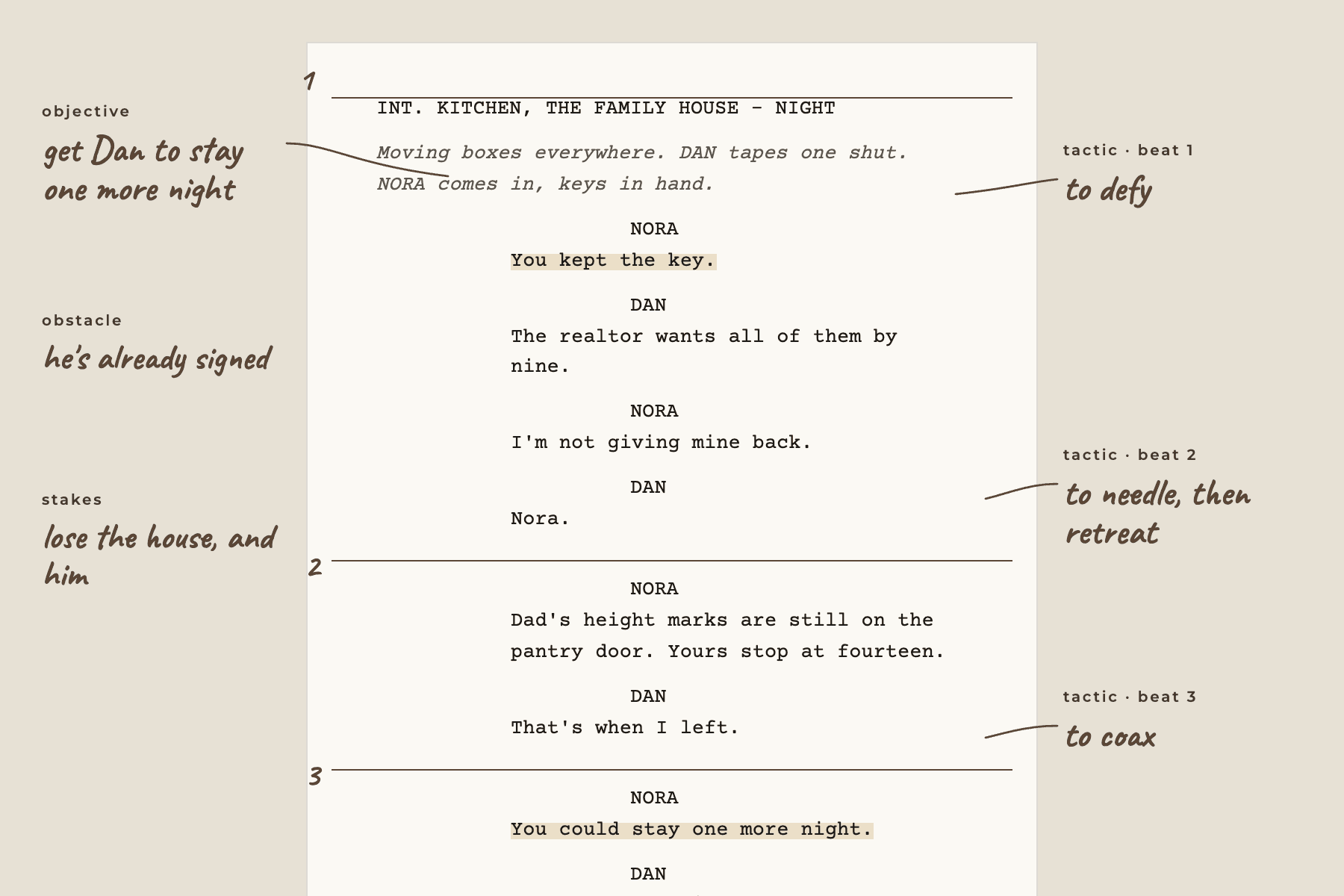
Scene studyGuide
How to break down a scene, step by step
A simple, repeatable way for actors to break down any scene (objectives, obstacles, stakes, and beats) so you walk in specific instead of vague.
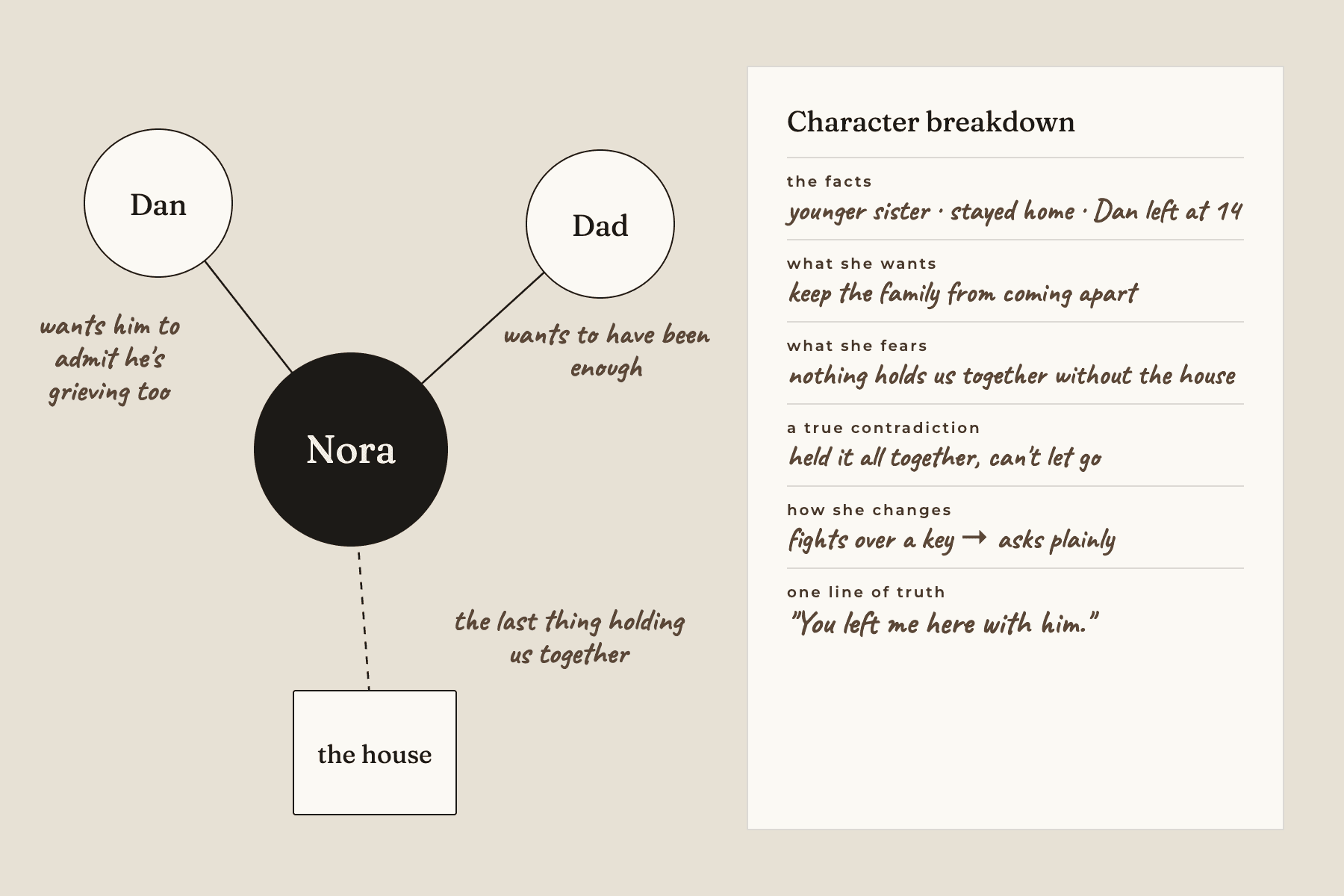
Character workWorksheet
The actor's character breakdown worksheet
A free printable character breakdown worksheet for actors: the questions that turn a role on the page into a specific, living person you can play.