CareerGuide
How to organize your acting career
Four places for four kinds of information, a fixed-order weekly review, and a sample week showing how one repeated observation becomes one decision.
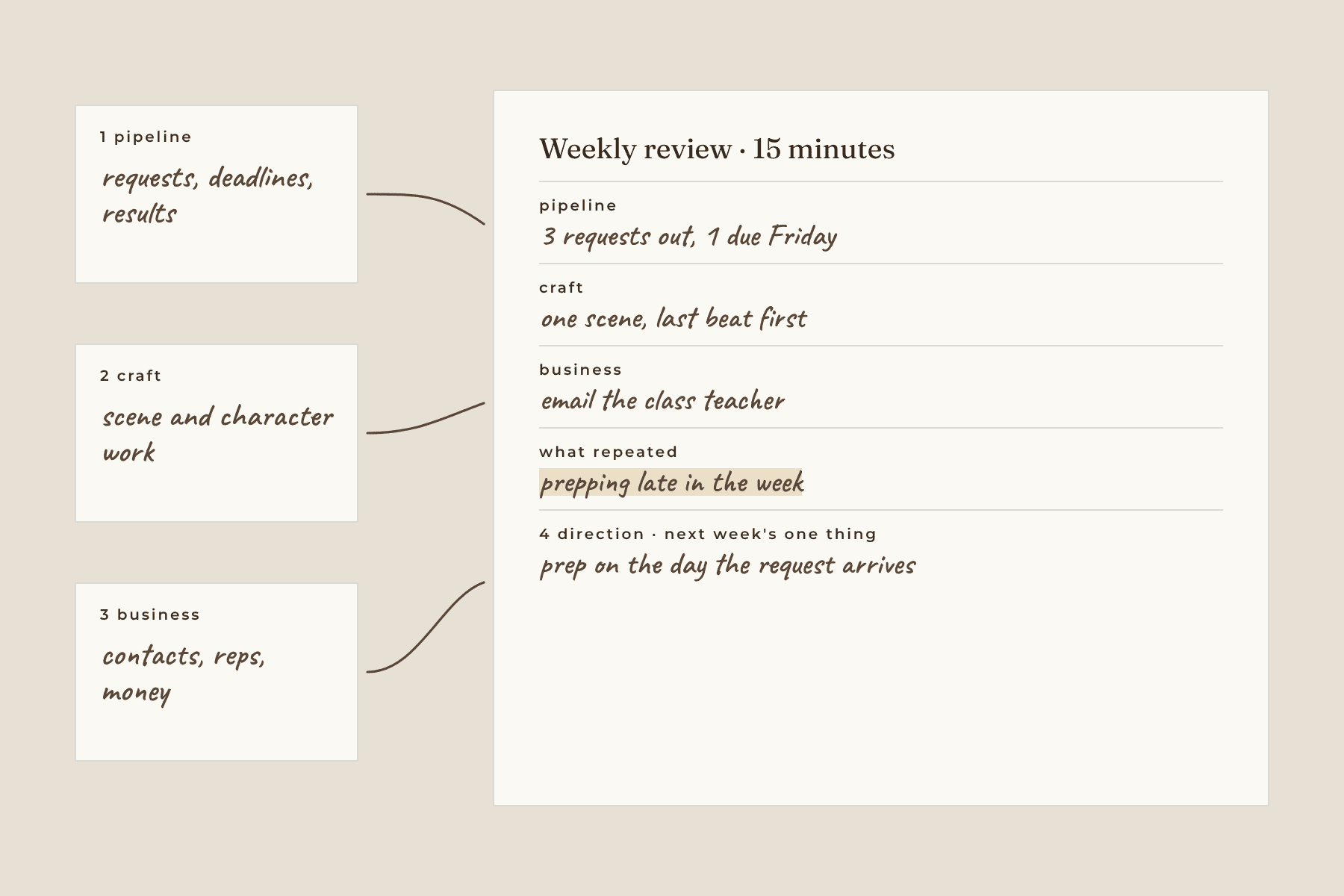
Sort everything you track into four parts by what it is for: the pipeline (requests, deadlines, results), your craft work, your business admin, and your direction. Then spend fifteen minutes once a week looking at them in that order and choose one thing for the next seven days. That is the whole system. The rest of this guide shows where each kind of information goes, how the review runs, and what a sample week looks like.
What "organized" means for an actor
It does not mean colour-coded folders. Actors collect many kinds of paper: an email with sides, a note about the character's mother, a casting office's deadline, the name of a teacher you want to write to, a goal you made in January. Put them all in one stack and none is findable. Put each in its own app and you will not open half of them.
The fix is to sort by what the information is for. Four purposes cover most of an acting career:
- Pipeline: work that is coming in or waiting on an answer.
- Craft: the work you do on scenes, characters and technique.
- Business: the people and admin around the work.
- Direction: where you are aiming and what you will do next.
Each part answers a different question, and each needs a different habit. The pipeline needs fast updates. Craft work needs time. Business needs a small regular tidy. Direction needs a pause to look up.
The four parts and where things go
| Part | The question it answers | What lives here | Where to read more |
|---|---|---|---|
| 1. Pipeline | What is in play right now? | Requests, deadlines, instructions, preparation notes, after-the-room notes, results with dates | How to track auditions |
| 2. Craft | How am I getting better at the work? | Scene breakdowns, character work, cold-reading practice, class notes | Break down a scene, the character worksheet, cold reading tips |
| 3. Business | Who and what supports the work? | Contacts and follow-ups, your materials (headshots, reel, résumé), classes you have taken or want to take, representation notes, a simple record of income and expenses | Your own pages; the planner below has set layouts |
| 4. Direction | Where am I aiming? | A goal or two for the quarter, what worked and what to change, one decision for next week | This guide's weekly review |
A few rules keep the sort honest:
One home per note. An audition lives in the pipeline log, even if it taught you something about craft. Write the craft lesson in the craft part and put a pointer in the log ("see the Key scene notes"). Duplicating it is how systems drift.
Pipeline and craft are different. The log records what happened. Craft pages record what you are practising. If your choice for an audition came from a scene breakdown, the log holds one line (the choice) and the breakdown holds the thinking.
Business is the part that gets skipped. It has no deadline until it does. Keep a short list of follow-ups, and look at it every week, so a thank-you note or a class sign-up doesn't wait for a good mood.
Money records are yours to keep and understand. This guide does not give financial or tax advice. If you track income and expenses, keep the record simple and ask a qualified adviser where your own rules are concerned. They vary by country and by how you are employed.
The 15-minute weekly review
Pick a time you can repeat, such as Sunday evening or Friday afternoon. Set a timer. Go through the parts in this order and write one or two lines for each.
Step 1: Pipeline (3 minutes)
Update every open request: status, deadline, anything you are waiting on. Write results with their dates. Note the count: how many requests are out, and what is due this week. Don't analyse yet.
Step 2: Craft (3 minutes)
What did you work on, and what will you work on? Choose one scene, one character question or one drill for the coming week. Link it to the pipeline if you can: a request due Friday makes the choice for you.
Step 3: Business (3 minutes)
Open your follow-up list. Do one thing from it that takes under five minutes, such as a short email, and write down the next one.
Step 4: What repeated (3 minutes)
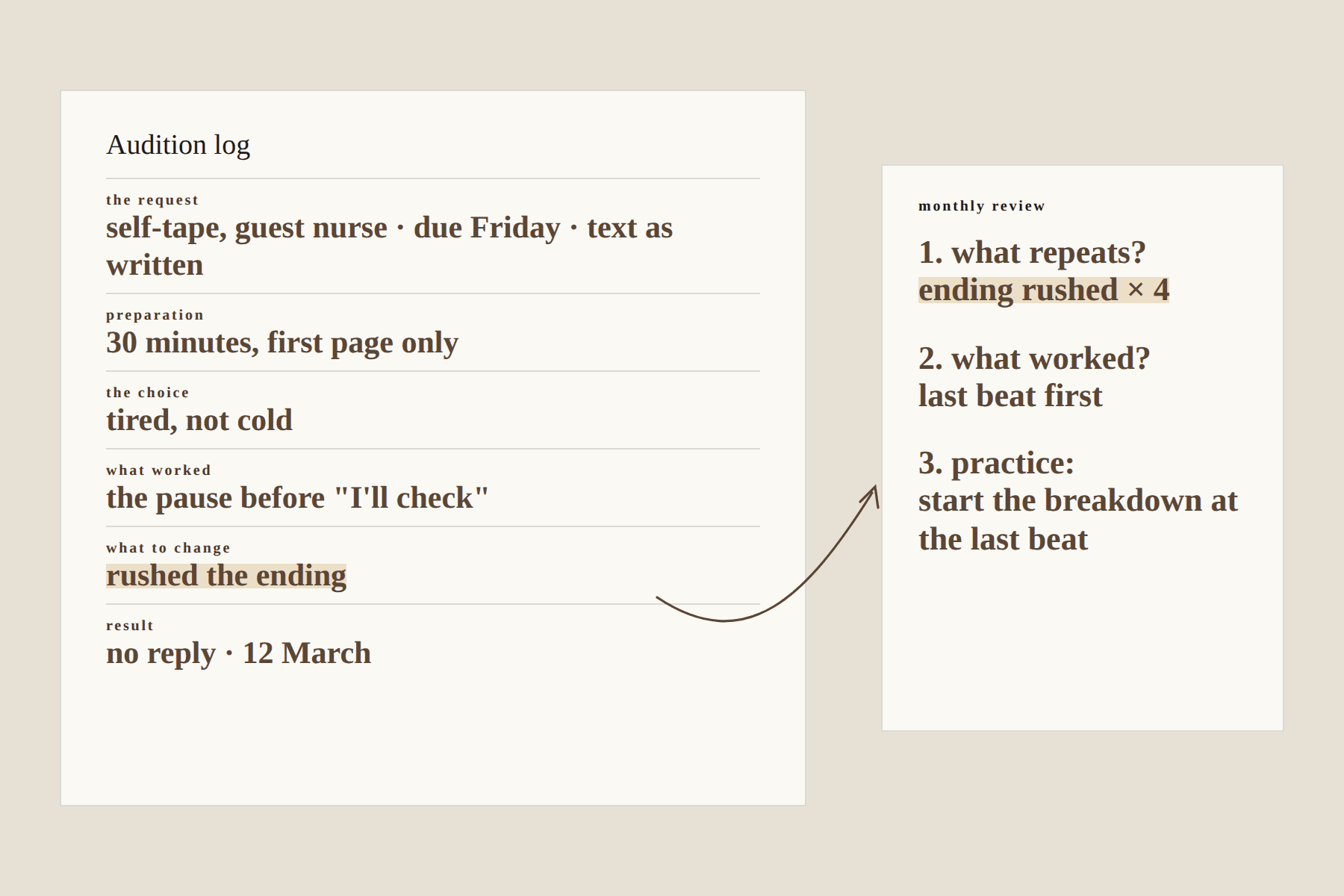
Read your notes from steps 1 to 3 and from your after-the-room notes. Is there a word or situation that showed up more than once? If you log your auditions, the monthly review in the audition guide goes deeper. The weekly version only asks: did anything repeat?
Step 5: Direction (3 minutes)
Look at your goal for the quarter. Choose one thing for the next seven days. Write it as an action you can see yourself doing: "Start the breakdown on the day the request arrives", not "be more prepared".
A sample week
Here is one review for an invented actor. This is a Vitoniou teaching example: the actor, requests and contacts are made up for this guide, and one week is far too little to show what any system does over time. It shows how the four parts feed each other.
Worked example · one weekly review (hypothetical)
1. Pipeline. Three requests are out: a streaming guest role (self-tape sent Tuesday, no reply yet), a short film (callback Thursday) and a commercial (tape due Friday). Count: three out, one due this week.
2. Craft. The short-film callback has a new scene. The actor chooses one thing: break down the scene and prepare the last beat first.
3. Business. The follow-up list holds four items. The actor emails a class teacher to ask about a spring term (two minutes) and adds "update reel link on profile" as the next item.
4. What repeated. Reading the last three after-the-room notes, the actor finds the same word twice: "late". Both tapes were prepared the night before they were due, and both notes say the work felt rushed.
5. Direction. The quarter's goal is "send more considered tapes". This week's one thing: prepare for each request on the day it arrives, even if only for twenty minutes.
Notice what the review does not do. It doesn't try to explain why the streaming role hasn't replied. It doesn't set five new goals. It uses the pipeline to decide the craft work, notices one pattern, and turns it into a single action for a week.
Set it up in thirty minutes
The free audition tracker covers the pipeline part: a weekly log and four reflection prompts on one printable page. Start there if you have nothing yet.
Practice exercise
Build the four-part system
- Task
- Create one home for each part and run your first review.
- Time
- About 30 minutes, once.
- Choose your tool: a notebook with four labelled sections, four pages, a folder with four documents, or four notes. Name them Pipeline, Craft, Business and Direction.
- Pipeline: list every audition or request that is open today, with its deadline.
- Craft: write the one scene or character you are working on. If you have none, write the next sides you expect to prepare.
- Business: list up to five follow-ups (people to thank, materials to update, a class to look at).
- Direction: write one goal for the next three months in a single sentence, and one thing you will do this week towards it.
- Set a recurring reminder: "Weekly review, 15 minutes". Choose a time you actually have.
OutcomeFour named homes, a first set of entries and a calendar reminder for next week's review.
Where to go next
If the pipeline is your weakest part, start with how to track your auditions. If your craft work is scattered, the scene breakdown method and the character breakdown worksheet give you repeatable ways to prepare. If you are choosing what to study, acting techniques explained compares eight approaches. And if you often get sides with little notice, the timed drill in cold reading tips belongs in your craft part.
Questions
Do I need a digital tool to organize my acting career?
No. A printed page, a notebook, a spreadsheet and a notes app all work. Choose the one you will open in a slow month, and keep the four parts the same whatever you choose.
How long should a weekly review take?
Fifteen minutes is enough for most weeks: three minutes for each of the first three parts, three to find what repeated, and three to choose one thing for next week. If it keeps running long, you are probably planning instead of reviewing.
What if I only have one audition a month?
Run the same review. A quiet week still has craft work, business admin and a direction to check. The review is also how you notice that the pipeline part is empty and decide what to do about it.
Written by
The people who design Vitoniou's journals and workbooks for actors and film creatives. We write these guides to teach the methods our printables are built around, and we update them when we improve them.
Read next
AuditionsGuide
How to track your auditions (and learn from them)
How to track auditions as an actor: the six fields worth writing down, when to fill each in, and a monthly review that turns the log into one thing to practice.

Scene studyGuide
How to break down a scene, step by step
A simple, repeatable way for actors to break down any scene (objectives, obstacles, stakes, and beats) so you walk in specific instead of vague.
Character workWorksheet
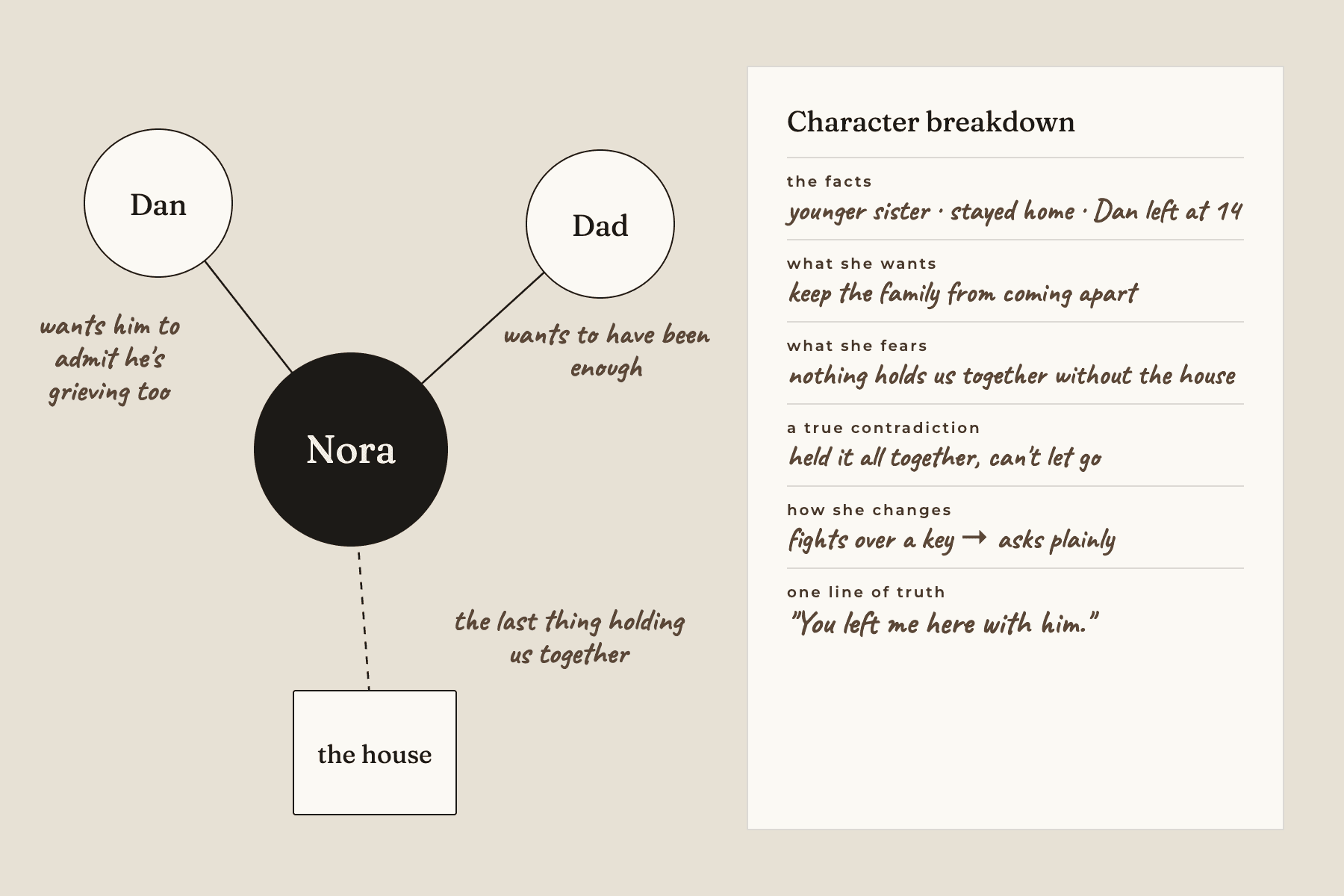
The actor's character breakdown worksheet
A free printable character breakdown worksheet for actors: the questions that turn a role on the page into a specific, living person you can play.