Scene studyGuide
What to write in an acting journal
A four-line entry you can finish in ten minutes, a worked week showing vague lines rewritten into usable ones, and prompts sorted by the moment you need them.
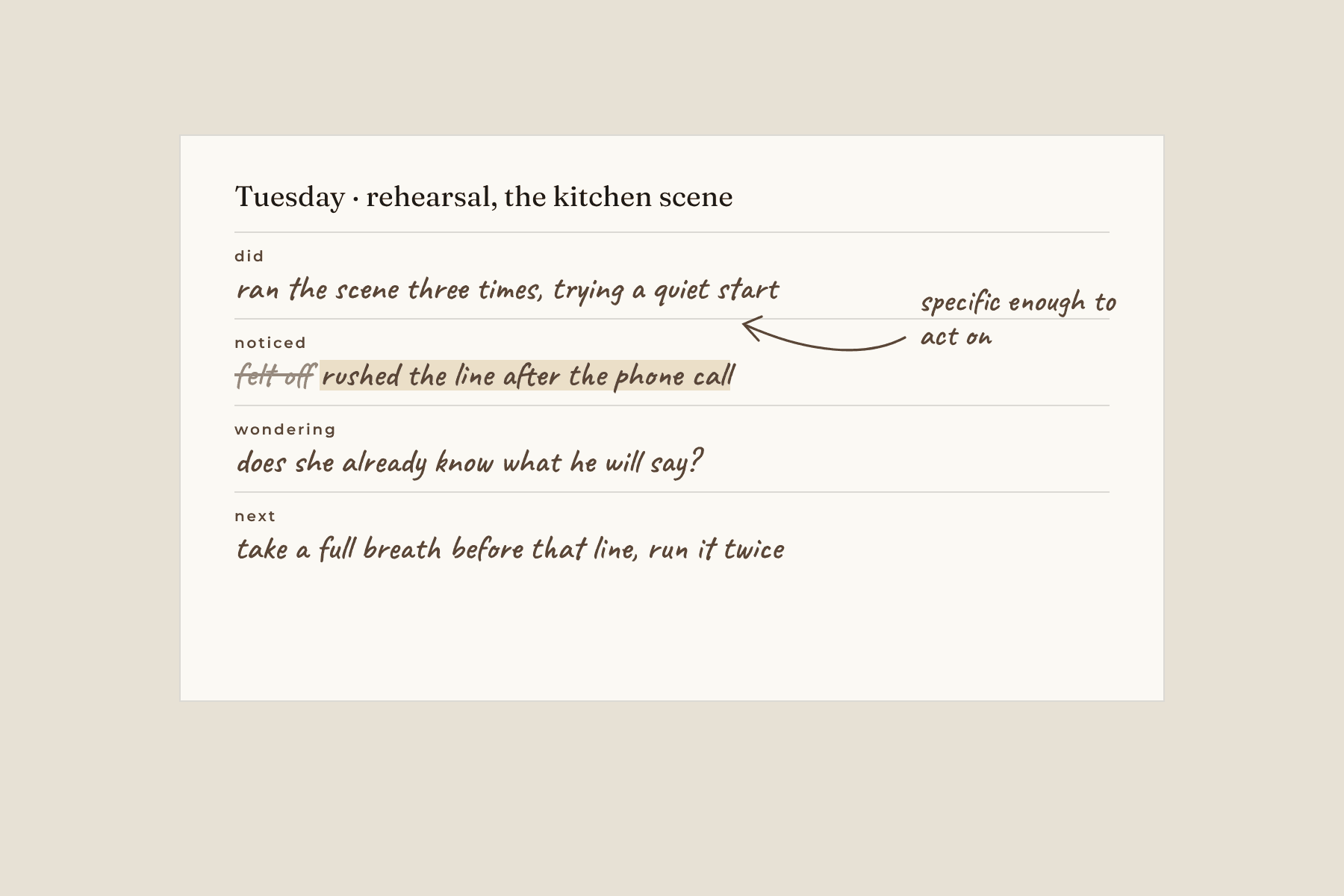
After every rehearsal, class or audition, write four lines: what you did, what you noticed, what you still don't know, and one thing to try next. Ten minutes is plenty. That entry is the whole method. The rest of this guide shows what each line should contain, what to write at four different moments, how to turn "felt off" into something you can act on, and a bank of prompts for the days you stare at a blank page.
What an acting journal is for
A journal is a place to keep what you learn so it survives a busy week. It isn't a performance review, and it isn't a diary of your mood. The test is simple: could you read an entry a month later and know what to do differently?
Stanislavski presented his account of an actor's training as An Actor's Work: A Student's Diary, a book that takes the form of a student's journal. That is the only claim we make about the tradition. The entry below is Vitoniou's own method, and it works for any approach to acting, including the ones compared in acting techniques explained.
Three jobs a journal can do for you:
- Remember. Which choice did you try on Tuesday, and what happened when you did?
- Notice. What keeps repeating across scenes, classes and auditions?
- Decide. What will you do first next time?
If an entry does none of these, it's probably a diary entry. That is fine as writing, but it won't help you rehearse.
The four-line entry
Write the lines in this order. Each has one job.
Step 1: Did: what you actually did
One line of fact. The scene, the exercise, what you tried. "Ran the kitchen scene three times with a quiet start." Don't evaluate yet.
Step 2: Noticed: what you saw or heard yourself do
One line of observation. Describe behaviour, not a verdict. "Rushed the line after the phone call" rather than "bad rhythm". If you feel the urge to write "felt off", ask: off where? Then write the where.
Step 3: Wondering: what you don't know yet
One question you can't yet answer. "Does she already know what he will say?" A good question points at the script or at your choice, and you can take it into the next rehearsal or to your scene partner or teacher.
Step 4: Next: one thing to try
One action, written so you could start it tomorrow. "Take a full breath before that line and run it twice." Not "be more present".
If you want to record how you felt, add it after the four lines or put it in the margin. Feelings are information, but they are easier to use once the behaviour is written down beside them. Many printed journals, including The Actor's Journal below, give you a separate space for feelings.
What to write at four moments
The same four lines work everywhere. What changes is the question you ask yourself at each moment.
| Moment | What to write | Time |
|---|---|---|
| Before a rehearsal or audition | One thing you will try, and one question you want answered. Skip "did" and "noticed" until afterwards. | 2 minutes |
| After a rehearsal or class | The full four-line entry. | 10 minutes |
| After an audition | The four lines, plus a pointer to your log. Keep the result out of the entry; it arrives later and says little about the work. See how to track your auditions. | 10 minutes |
| After watching a film, play or class | One choice an actor made, what it did to the scene, and one thing you could try. | 5 minutes |
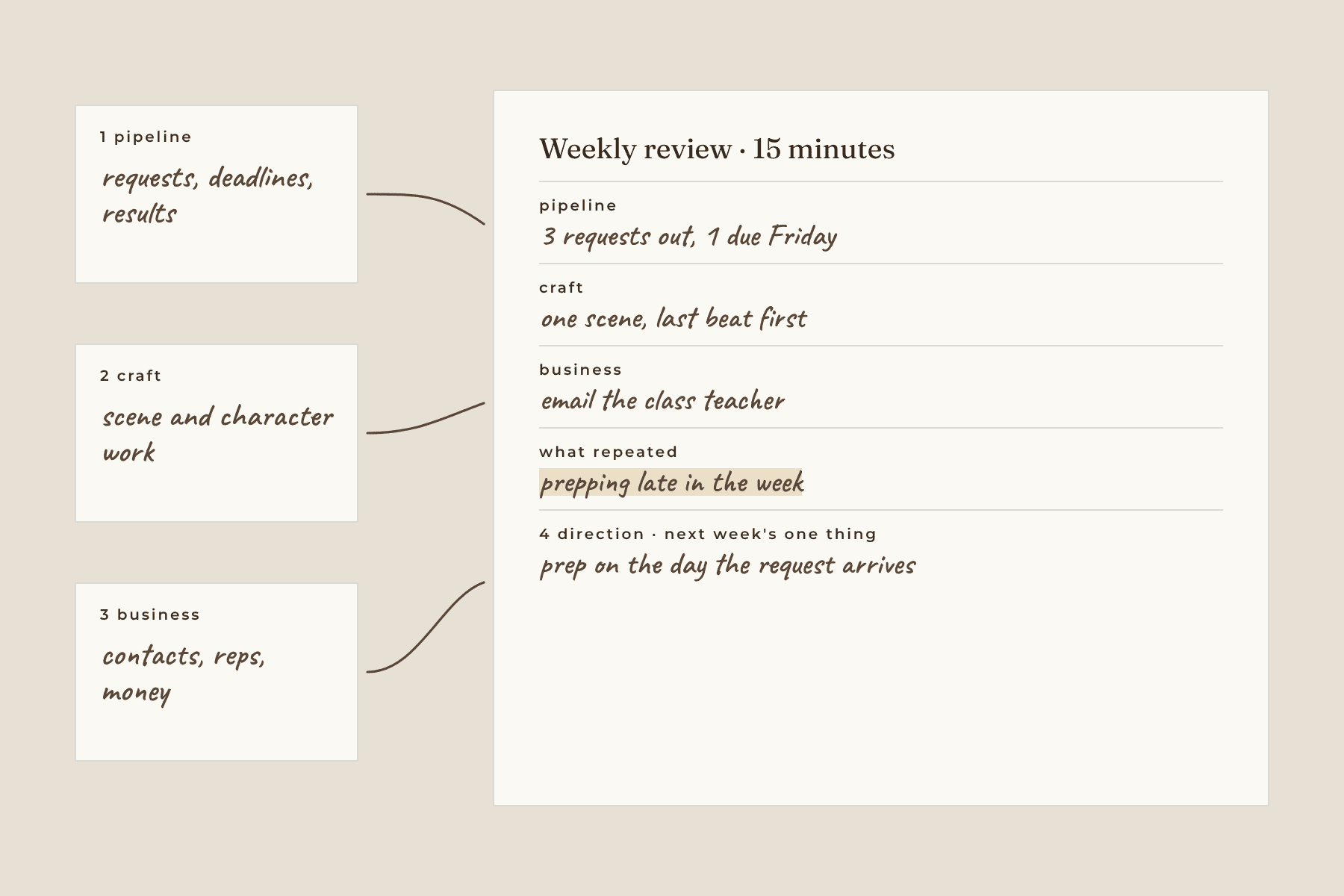
Keep the journal and the audition log separate. The log answers "what was in play and what happened". The journal answers "what did I learn and what will I try". If you run a weekly review, the journal belongs in the craft part of the four-part system.
A worked week
Here is one week of entries for an invented actor rehearsing a scene called "the kitchen scene". This is a Vitoniou teaching example: the actor, scene and entries are made up for this guide, and a week is too little to show what a journal does over months. Each entry shows the vague version first, then the rewrite.
Worked example · one week of entries (hypothetical)
Monday, solo prep. Vague: "Read the scene. Feels important." Rewrite: Did: read the scene aloud twice and marked every time she changes the subject. Noticed: she changes the subject three times, always right after he mentions his brother. Wondering: is she protecting him or herself? Next: try the first change of subject as protection, the second as self-defence, and see which feels truer.
Tuesday, rehearsal. Vague: "Felt off." Rewrite: Did: ran the scene three times with a quiet start. Noticed: rushed the line after the phone call, all three times. Wondering: does she already know what he will say? Next: take a full breath before that line and run it twice.
Wednesday, no rehearsal; watched a short film. Vague: "Great acting, learned a lot." Rewrite: Did: watched a short film, one scene twice. Noticed: the actor waited a full second before answering the question, and the scene felt more dangerous. Wondering: is my pause on Tuesday's line that kind of pause, or am I just stalling? Next: try a one-second pause before "I'll check", and ask my scene partner what they saw.
Thursday, class. Vague: "Teacher said I was in my head." Rewrite: Did: performed the scene once for the class. Noticed: my teacher said I looked away when she mentioned the brother, and she asked why. Wondering: is looking away a choice or a habit? Next: run it twice, once looking at my partner the whole time and once choosing exactly when to look away.
Friday, short audition for a different part. Vague: "Nerves." Rewrite: Did: audition for a guest role, prepared the night before. Noticed: I started speaking before the reader finished the cue. Wondering: would an extra breath help here as well? Next: use the same full breath before my first line next time. (Result goes in the audition log when it arrives.)
What the week shows. Two entries ended with the same fix, a breath before a key line, and Wednesday's pause is a close cousin. That repeat is the point of the journal. A reader of the vague versions would find a mood. A reader of the rewrites would find a plan.
From vague to usable: a rewriting test
When an entry feels vague, run it through three questions.
| If your line says... | Ask | Rewrite as... |
|---|---|---|
| "Felt off" | Off where, and when? | The line, moment or transition where it happened |
| "Was in my head" | What was I doing instead of listening? | What you were doing: planning the next line, watching yourself |
| "Good session" | What worked, specifically? | The choice or action that produced the good moment |
| "Need to be more present" | What would I do differently? | One thing you can see yourself doing |
A rewritten line has a noun and a verb in it. If you can picture it, you can rehearse it.
Prompts by moment
Use these on the days you stare at the page. Pick one or two, not all of them. These are original to Vitoniou and are meant as starting points.
Before working on a scene
- What does my character want from the other person in the first line?
- What is one fact from the script I am relying on, and where exactly is it?
- What is the riskiest choice I could try today?
After rehearsal or class
- Where did I stop listening, and what was I doing instead?
- Which line changed when I changed my intention? What did it change to?
- What did my scene partner give me that I didn't use?
After an audition
- What was the first choice I made, and did I hold it?
- What did I do with the first five seconds in the room?
- What would I keep exactly the same next time?
After watching a performance
- Which moment did I believe most, and what exactly was the actor doing?
- What did the actor do while the other person was talking?
- What is one small thing I could borrow, adapted to my own way of working?
On a day with nothing scheduled
- Which scene do I expect to prepare next, and what do I already know about it?
- What is a habit I notice in my work that I would like to test?
- What question would I ask a teacher if I had two minutes?
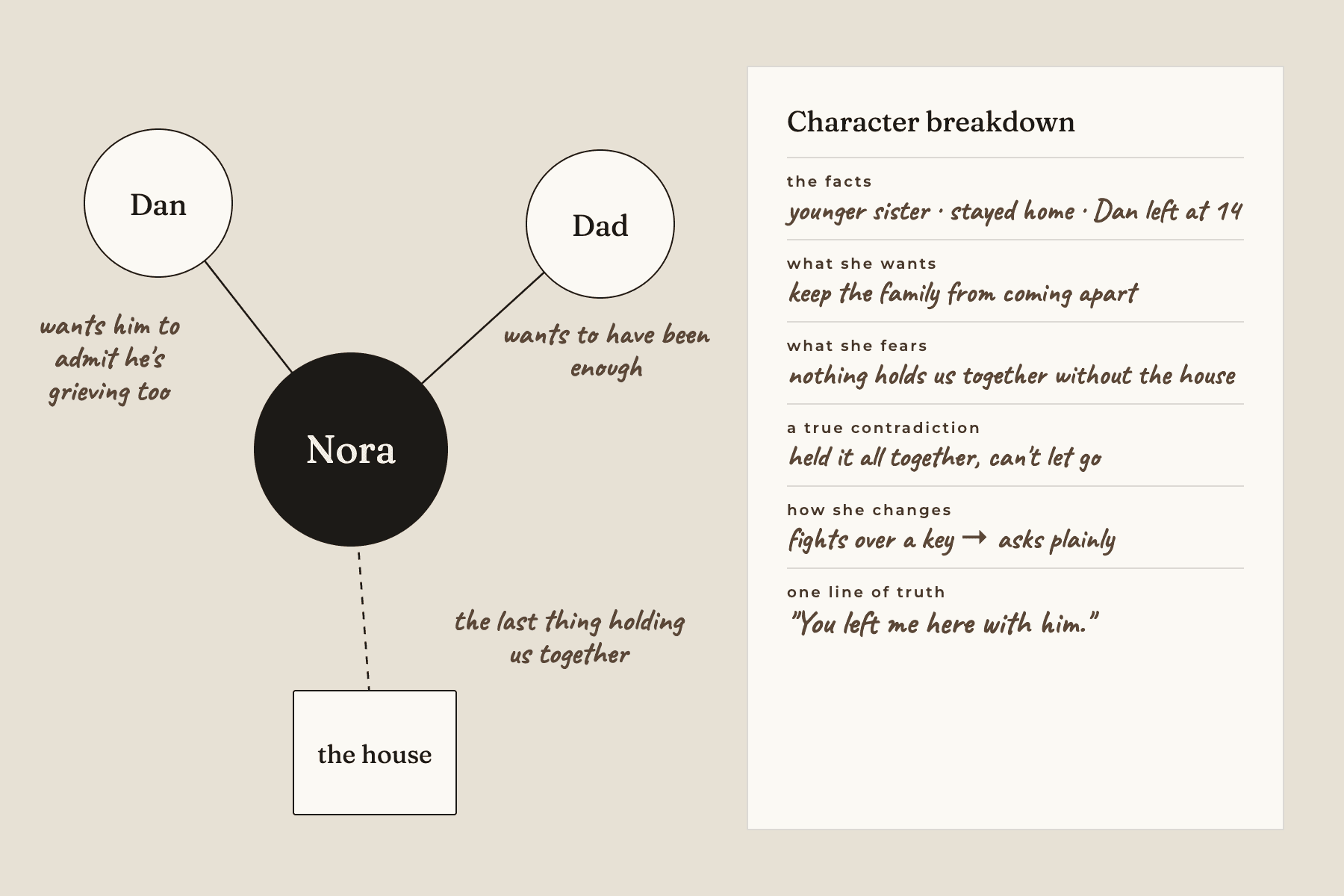
If you want a structured way to prepare the scene itself, the scene breakdown method and the character breakdown worksheet give you the facts to write against.
Set up your journal in ten minutes
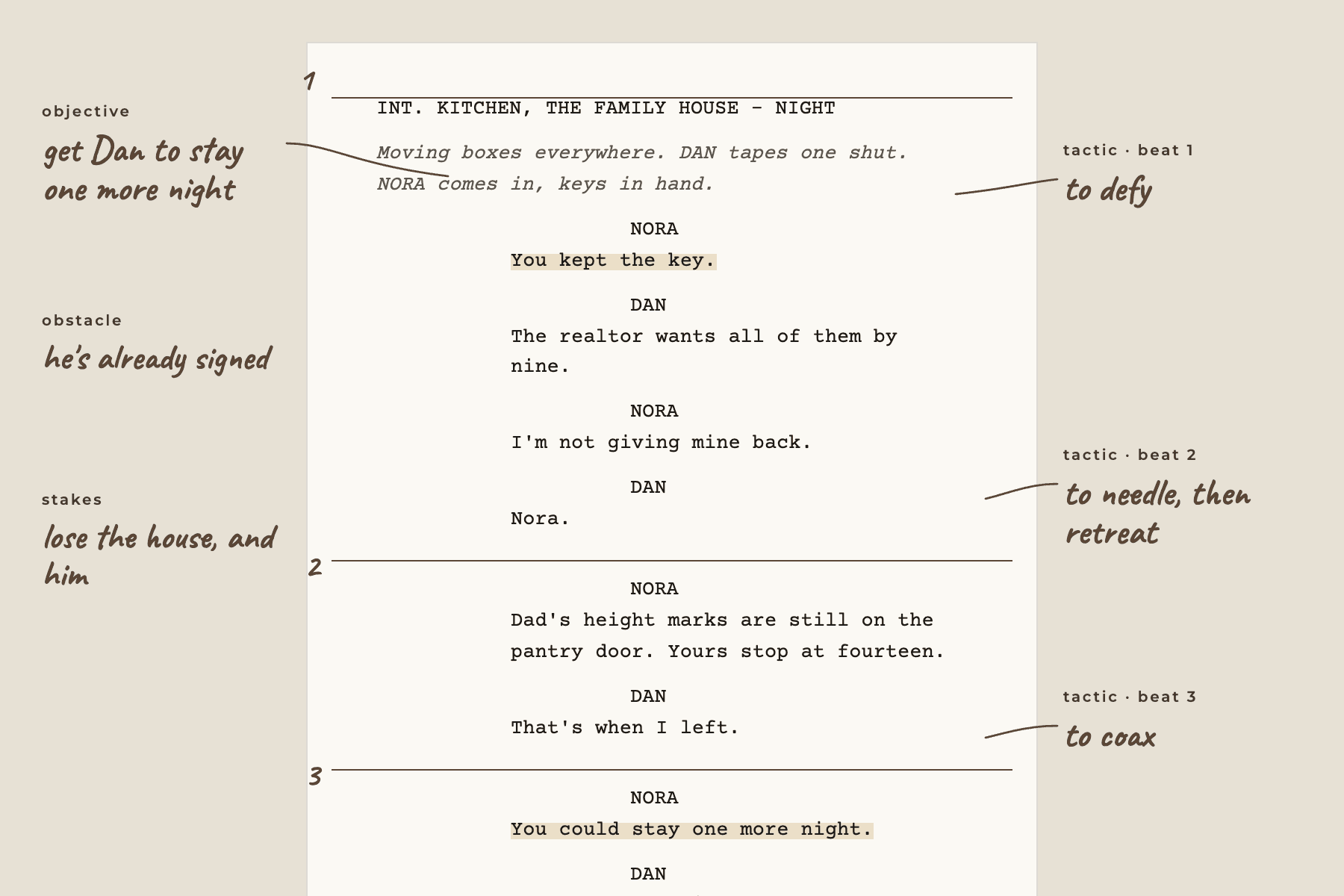
The free scene breakdown worksheet gives you the facts of a scene on one page: objective, obstacle, stakes and beats. Keep it beside your journal, so your "noticed" line can point at a specific beat.
Practice exercise
Write your first three entries
- Task
- Write one entry for each of three different moments, using the four lines.
- Time
- About 10 minutes for each entry; do one per day.
- Choose a notebook or a document and write the four labels on the first page: did, noticed, wondering, next.
- Today: write a before entry for the next thing you will work on. One thing to try and one question.
- After the work, write the four-line entry. Cross out any "felt" line that doesn't say where. Rewrite it.
- The next day, write an entry about something you watched, in five minutes.
- On the third day, read all three entries. Is any word, line or habit repeated? If so, write it at the top of the next page and make it your next "next".
OutcomeThree entries, one repeated observation if there is one, and a first 'next' you can act on.
Where to go next
If your journal sits inside a wider system, how to organize your acting career shows where it fits in a weekly review. For the audition side, use how to track your auditions and keep that log separate. For preparation, how to break down a scene and cold reading tips give you things to write about.
Questions
How long should an acting journal entry be?
Four lines is enough: what you did, what you noticed, what you still don't know and one thing to try next. Ten minutes is a good ceiling. A short entry you write every time is more useful than a long one you write twice.
Should I write by hand or on a device?
Use whichever you will actually open after a tiring rehearsal. Handwriting suits some actors and a notes app suits others. What matters is that the four parts of the entry stay the same.
What do I write if I had no rehearsal or class that day?
Write about what you read or watched. Note one choice an actor made on screen, what it did to the scene, and one thing you could try in your own work. Or write about the next scene you expect to prepare.
Written by
The people who design Vitoniou's journals and workbooks for actors and film creatives. We write these guides to teach the methods our printables are built around, and we update them when we improve them.
Sources
- Konstantin Stanislavski, translated by Jean Benedetti. An Actor's Work: A Student's Diary. Routledge. The title and subtitle show that Stanislavski's account of training is written in the form of a student's diary. Used only for that framing; Vitoniou's four-line entry is our own method, not Stanislavski's.
Read next
CareerGuide
How to organize your acting career
How to organize your acting career: sort what you track into four parts (pipeline, craft, business, direction) and run a 15-minute weekly review that sets next week's one thing.
Scene studyGuide
How to break down a scene, step by step
A simple, repeatable way for actors to break down any scene (objectives, obstacles, stakes, and beats) so you walk in specific instead of vague.
Character workWorksheet
The actor's character breakdown worksheet
A free printable character breakdown worksheet for actors: the questions that turn a role on the page into a specific, living person you can play.